Friday, April 27, 2012

The Five Year Engagement ★★★

A Film Proving That The Romantic Comedy Is Not Dead

Written by Matt Giles
Edited by Erin Accomando

It's shameful to say that in the last twenty or more years I can count the number of good romantic comedies on one hand. With that in mind, I'm quite delighted to say that The Five Year Engagement is one more rom-com that I can add to that short list.

As the title implies, this is a film about Tom and Violet's struggle to make it to the alter over the course of five years. Tom is a San Francisco chef that proposes to the love of his life, Violet, on their one-year anniversary. When Violet gets accepted to University of Michigan's psychology program instead of Berkley's, Tom quits his job to move with her. As Violet excels with her psych group, Tom struggles with the fact that he can only get a job making sandwiches at Zingerman's Deli. This undoubtably puts a strain on their relationship and with every new hurtle that comes their way, the wedding is delayed further. 

The last film that I can remember caring about the main characters as much I do in The Five Year Engagement was When Harry Met Sally. The key to both films is having an on-screen couple, or potential couple, that we as an audience are truly, emotionally invested in. Jason Segal and Emily Blunt do stellar work as their respective Tom and Violet. There's something so natural about each of them that from the moment we first see these two, we're rooting for them. They're a couple that goes through what many couples have to go through and nearly every reaction that each of them has to the other never feels forced or false. 

Jason Segal also co-wrote the script with director Nicholas Stoller (their first film together being Forgetting Sarah Marshall) and I must say that these two have a gift for writing honest material. I recently read that the funniest moments in life and in film are those that are the most real. Take for instance the opening scene of the film, which features a quite nervous Tom trying to conceal the fact that he is going to propose from Violet. The way Segal plays it is so genuine and believable it is one of the funniest scenes of the movie, and we're not even into it five minutes. The scenes where Tom and Violet are fighting, or when their simply walking the streets of Ann Arbor are perhaps the most memorable and the funniest because again, we see these characters as real people. 

The film goes back and forth from San Francisco to Ann Arbor, which is important to note because so many films these days do not use location as a character. One of the criteria I look for in my favorite films is how location is used to better the story. Michigan serves as the foil to all of Tom's plans and it could not be more effective. They show Ann Arbor for what it is: a college town that's both simultaneously beautiful and frigidly devastating depending on what time of year it is. Yes, Michigan is portrayed as unbearably cold, and with the primary pastime being hunting. Or, as I like to call it, Michigan. Living in Michigan, I have to admit that seeing a film like this use it as a character is quite humbling. It's not often films showcase our state and when they do I'm always grateful. 

The Five Year Engagement is not a perfect film, but it's damn good. It's a film that recalls great onscreen couples like Harry and Sally, or the best of the Ginger Rogers/Fred Astaire films, and one of my personal favorite films, It Happened One Night. While we still may only be able to count good rom-coms on one hand, The Five Year Engagement gives me hope that we'll be able to add many more to that list, especially if Segal and Stoller continue with the amazing work they're doing. 
Saturday, April 21, 2012

4:44: Last Day On Earth ★

A Sadly Missed Opportunity

Written by Matt Giles
Edited by Erin Accomando and Jason Umpleby

If you knew that the world would end at 4:44 A.M. the following morning, what would you do? That question is at the heart of Abel Ferrara's film and it is one that accurately depicts what would most likely happen if this scenario were occurring in real life.

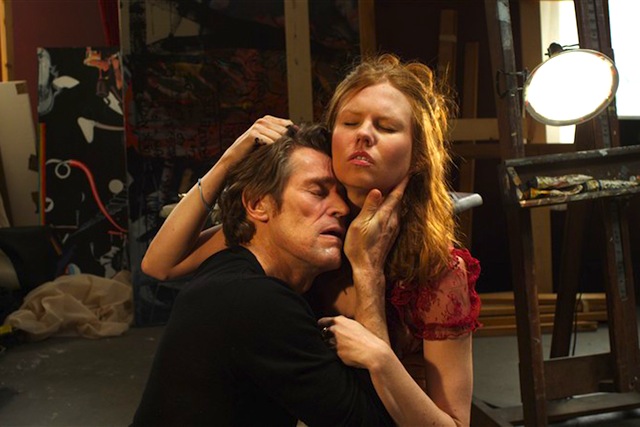
The film focuses on two characters: Cisco (Willem Dafoe) and Skye (Shanyn Leigh); a couple living in New York trying to accept a fate from which neither of them can escape. We're shown their various stages of grief throughout the day that each of them experiences, and how those emotions impact their next action.

I have to say that while I admire the courage of this film, I cannot necessarily recommend it. There are films that have been depressing beyond the point that we should still like them, yet we do. This, unfortunately, is not one of them. While I understand Ferrara's point - that even if the world is ending we cannot lose who we are - I'm not so sure it's handled in an interesting enough way for film.

Looking at the main characters, Cisco and Skye are two people that no matter how hard I tried, I was never rooting for them in any way. They're not very compelling on-screen, though Dafoe does his best with the material he's given, and there's never a moment where I felt genuine sympathy for either of them. There's visually no chemistry between them - much less attraction to one another - which makes me wonder why they were ever a couple in the first place. I think that for a story/film like this to work, and for Ferrara to achieve his desired goal, we need to really fall in love with these characters thereby making us really care about who they are so that when the issue arises, we want them to stay true to themselves. There is none of that in this movie.

There's a scene where Cisco, after having quite an uncomfortable fight with Skye, goes to an old friend's house in an attempt to get high one last time. Yes, randomly we learn that Cisco is a recovering drug addict, sober for a little over two years. One of his friends (also recovering) explains to Cisco that he's proud of the man he has become and he's not willing to sacrifice that just because everyone is about to die. He argues that Cisco should feel the same about his own life. Cisco doesn't agree. A scene like this could work if it had been established earlier that he was an addict, and was still struggling with on a daily basis. Instead, we wonder why he's headed to this apartment until it's casually revealed through conversation that he once had drug problems.

Having said all that, I found this film to be better than the 2011 favorite, Melancholia, because the end of the world is used to examine the very meaning of humanity, whereas Melancholia felt like two separate stories that were forced into one another. It should be noted, however, that if there was a way to put a film in a less-than-zero category, Melancholia would be there.

I wish 4:44 had more to offer. Sadly, it made me wish the world was ending just so I would not have to endure these two characters any longer. 

Sunday, April 15, 2012

The Cabin In The Woods ★

Over Praised And Sadly A Bit Underwhelming

Written by Matt Giles
Edited by Erin Accomando and Jason Umpleby

This will probably be the trickiest review I write considering I have to be quite careful of venturing into spoiler territory. Let’s start with this: there’s a cabin in the woods; five college students arrive to party it up over the weekend; chaos ensues. Sounds familiar right? Well, it is and it isn’t. The film, written by Joss Whedon and Drew Goddard, directed by Goddard, tries to turn the conventions of a typical horror film on it’s head (or does it) and give us something we’re not expecting. There’s the jock, Curt (Chris Hemsworth), the ditzy blonde, Jules (Anna Hutchison), the stoner, Marty (Fran Kranz), the scholar, Holden (Jesse Williams) and the virgin, Dana (Kristen Connolly). Based on all of these character types, we can guess who will die first (or can we?). At the same time, we’re shown two technicians, Sitterson (Richard Jenkins) and Hadley (Bradley Whitford) who seem to be setting the events with the cabin in motion. I’ve probably revealed more than I should already.

I had been waiting for The Cabin In The Woods to come out since January of 2010. I’m a fan (not a huge fan, but a fan nonetheless) of Joss Whedon (and to all my fellow browncoats) and was interested to see what he would do with a familiar horror story. I was really looking forward to seeing how Drew Goddard would do from a directing standpoint. I have been more of a fan of Goddard’s work (he’s floated through many more of my favorite shows than Whedon) for the past few years and after seeing Cloverfield, a film that he wrote, I wanted to see what else he would do in the film world in addition to his already impressive television work.

Cabin kind of feels like a lackluster version of an already successful genre. Say what you will about horror. Like any genre sometimes it works, most of the time it doesn’t, but when it does, you remember it. For horror, in the last decade, I don’t think any film has left me more emotionally scarred than The Ring. More recently, the Paranormal Activity Films worked, scaring us in the simplest (but not cheapest) of ways. Every few years films like those come along and really find a new way to scare us. Then for years after that it’s done over and over again until something new comes our way. Why am I going on and on about this? Because The Cabin In The Woods promotes itself as being one of these films; something that will change how we perceive horror. Let me be in the minority by saying that this film does not succeed.

I was hoping that it would take an approach that, I guess, explained why these types of characters exist in movies. They explain the character types within the universe they create in the film, which when it’s revealed what’s really going on I simply said, “seriously?” Maybe that approach would work in another film, but I would argue that Whedon and Goddard should have taken the Scream route and acknowledged the fact that this stuff happens in almost every horror film. I don’t think (don’t quote me) the words “film” or “movie” are mentioned once and for a revisionist approach such as this one, they need to be.

Watching this film reminded me of better films in this specific category of horror, The Evil Dead, Friday The 13th, and yes, as twisted as it is, Antichrist. The Cabin In The Woods is basically Whedon and Goddard’s attempt (yes, attempt) at putting their spin on horror. There’s a degree of affection for the genre, which I appreciate, but it just takes itself too seriously. It wants to point out elements of the genre that we know about, but then tries to one-up those elements and kills its own impact in the process.

I wanted to love this movie. I wanted to praise both Whedon and Goddard. Whedon gets another chance with The Avengers in a few weeks. I guess I’ll have to wait a little longer to see if Goddard has the directing chops to last in film. 

Saturday, April 14, 2012

Footnote ★★★½

A Unique Look At A Father/Son Rivalry

Written by Matt Giles
Edited by Erin Accomando

Relationships between father and son are complicated to say the least. The film Footnote offers a darkly comical take on that relationship by setting the story in the world of academia, specifically in the Talmudic Research Department of the Hebrew University of Jerusalem. The father, Eliezer Shkolnik (Shlomo Bar Aba) is a philologist who studies different versions of the Jerusalem Talmud adhering to a strict view of their meaning. Eliezer is an outcast because of his old-school beliefs. Years back, another Professor, Yehuda Grossman (Micah Lewensohn), found similar results as Eliezer in his research but published them ahead of him, leaving Eliezer’s thirty years of work now pointless. It should be noted that Eliezer’s only claim to fame is a footnote in one of his former mentor’s books that everyone except Eliezer has long since forgotten. Meanwhile, Eliezer’s son Uriel (Lior Ashkenazi) is perhaps the most popular professor at the University, whose work does not include such a strict interpretation of Talmudic texts. Eliezer finds everything that Uriel believes in to be simple speculation and thus not worthy of his respect.

For years Eliezer has hoped to win the Israel Prize in recognition of his work and each year he has become more saddened and bitter because he never wins. Elsewhere, Uriel has made the point that as long as his father is alive and hoping to win the Israel Prize, he does not want to be recommended for the honor. When a mix up of names occurs, Eliezer is mistakenly told that he will be receiving the award he has so long hoped for, even though unbeknownst to him the award was intended to be given to Uriel.

What I love about this film is how it takes this idea of the father son strained relationship and raises the stakes to the highest level by placing true animosity on the role of the father to the son. Eliezer is a bitter old man who never got over being cheated out of his life’s work. Thirty years of work suddenly being taken away is something I think we can all sympathize with. Uriel on the other hand at first comes across as egotistical, then slowly throughout the film reveals himself to be an honorable man, still seeking his father’s respect and admiration.

There’s one scene in particular that lasts about ten minutes that I’m just in awe of. It’s got everything one could want in a movie: comedy, drama and yes, some suspense. It’s the scene where Uriel is called into the crammed office of the Israeli Prize committee to be informed of their error. In it, Uriel begs them to just give his father the award because, as Uriel states, he deserves it. One of the members on the committee is Professor Grossman, who has no intention of ever awarding Eliezer the Israel Prize. It’s a powerful scene; one that I think no matter who you are, you could sympathize with. For me, it’s the son pleading for his father in the most compassionate way that hits me hard. If it sounds like Uriel is trying to save his father’s life, well, he is. He tells the committee that if his father finds out about the error, it will likely kill him. Eliezer is a man so desperate for respect that to finally think he’s achieved it only to have it taken away would most likely drive him to suicide. Uriel, for all intents and purposes, puts his life on the line to help his father.

The whole film basically shows us the perspectives of each character; Uriel doing his best to get his father the award he deserves, and Eliezer running his mouth about his son’s “superficial” work, enraging Uriel to no end. The film is quite intense in that we never know what either character might do or say to the other. We see Uriel reaching his breaking point the more his father ridicules his profession, yet we see Eliezer’s determination to get the respect he feels his son and others have stolen from him and we’re sympathetic to both stories. It’s almost as if we either don’t know who to root for, or we’re rooting for both characters equally.

Keep in mind that this is all set within the world of academic research; a field that largely in my opinion goes under-appreciated in our country. Joseph Cedar, the director of this film does a brilliant job raising the stakes as it were and showing us how complex not only the research field is, but also how difficult the relationships between fathers and sons can be. I’m used to seeing films where the son just wants to make his father proud. Yes, there’s a large amount of that in this film and it all works. But for me, what sets this film apart from any other is the portrayal of the father whose desperate to achieve what his son has; just a little respect.

Footnote is currently playing at The Maple Theatre in Bloomfield Hills.